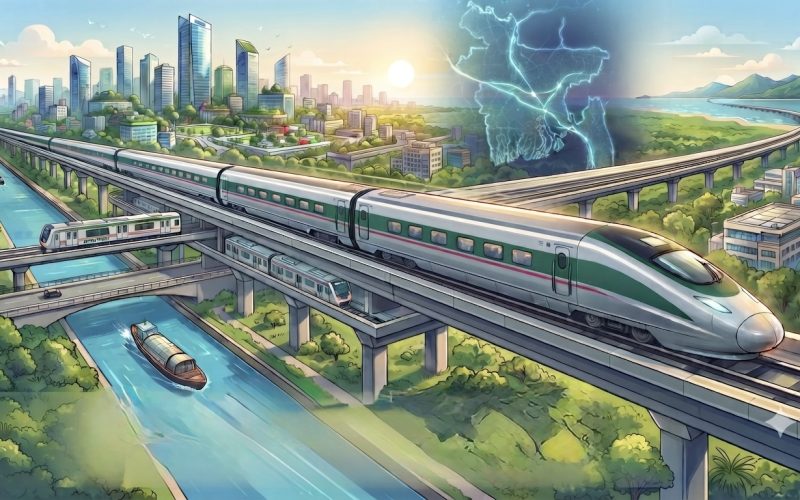
In the early 1970s, a visionary step was taken to rebuild Bangladesh’s war-torn economy and improve rural infrastructure—the canal-digging program. That visionary leadership of the time understood that strengthening the foundation of communication and irrigation was critical to keeping agricultural productivity and the rural economy afloat. In the 21st century, the modern transformation of that historical philosophy of connectivity could be the establishment of a nationwide bullet train network and metrorails in major cities. This groundbreaking infrastructural revolution will not only improve the transportation system, but will also take Bangladesh’s overall economy to entirely new heights.
Bullet Trains and Metrorails: The Main Drivers of Economic Growth
There is a profound relationship between a country’s GDP growth and high-speed transportation systems. Today, the excessive population pressure, severe traffic congestion, and unplanned urbanization in megacities like Dhaka are slowing down economic dynamism. The only way out of this crisis is to bring the country’s major divisional and economic hubs under a high-speed rail network and build a metrorail network in every major city to facilitate internal communication.
- Time and Fuel Savings: Ensuring high-speed travel on railways by reducing dependence on roads will recover wasted working hours and save billions of BDT in fuel.
- Expansion of Goods and Services Sectors: Raw materials and manufactured goods can be supplied from industrial zones to markets more rapidly, making the supply chain much more dynamic.
- New Employment Opportunities: The construction, operation, and maintenance of a modern railway network will create vast employment opportunities for engineers, technicians, and various service sectors.
Route-Based Potential Outlines: The Dhaka-Chittagong Corridor and Sylhet Connection
Imagine starting a journey from the capital Dhaka and reaching Cox’s Bazar directly via Comilla, Feni, and Chittagong in just 2 hours or even less! Similarly, making it possible to travel from the northeastern commercial hub of Sylhet to Chittagong in just 45 minutes! If this type of high-speed rail network is implemented, the conventional concepts of the country’s geography and economy will completely transform.
- Dhaka-Cox’s Bazar Economic Corridor: Establishing connectivity between Dhaka, tourist capital Cox’s Bazar, and port city Chittagong in just two hours will revolutionize domestic and foreign investment. The tourism industry will be able to operate at full capacity all year round.
- Sylhet-Chittagong Commercial Route: Bypassing the grueling and lengthy road journeys to travel between Sylhet and Chittagong in just 45 minutes will multiply trade, the tea industry, and remittance-based investments between the two regions.
Decentralization and the Benefits for Dhaka
For a long time, because all vital activities, education, healthcare, and employment opportunities were Dhaka-centric, the capital has become heavily populated and nearly uninhabitable. Once a bullet train-based connectivity system is introduced, decentralization will naturally accelerate. Consequently, Dhaka itself will reap several key benefits:
- Reduction of Overpopulation Pressure: When people can commute to Dhaka from Comilla, Sylhet, or Chittagong in just 1 to 1.5 hours and return to their hometowns the same day, the tendency to reside permanently in Dhaka will decline significantly.
- Improvement in Quality of Life: The housing crisis, severe traffic congestion, and environmental pollution levels in Dhaka will drop to manageable levels. Citizens will get back a clean and livable Dhaka.
- Regional Equality and Balanced Development: As other regions of the country become economically self-reliant, not only will Dhaka-bound congestion decrease, but the entire country will enjoy the benefits of economic growth collectively.
Conclusion
Just as the dreamers of the canal-digging movement in the 1970s outlined a way to save the rural economy for the future, the challenge for the current generation is to spread a web of bullet trains and metrorails across the country with the resolve to build a smart Bangladesh. This high-speed network will not merely shorten the distance between two cities; it will transform Bangladesh’s economy into a dynamic, modern, and decentralized global powerhouse.